The German tradition of sociology of culture is internationally recognised; following from the British model of cultural studies, the cultural sciences have long ventured analyses of society and power. Yet when attempts are made to bring together disciplinary formations in the social and cultural sciences, already differentiated in themselves, cooperation often remains limited to worn routines: sociologists citing from literary works to illustrate social contexts; literary scholars applying social theories to lend relevance to their interpretations of novels. On both sides, this means “using” elements of the other research field in ways that are not always well thought out – as a theory lecture or rhetorical strategy; as a reference to concepts and individual works whose aptness and claims to exemplary validity are not always verified.
At KWI, we take on concrete topics that – ideally – generate a less asymmetrical form of cooperation between researchers in the humanities and social sciences. We have explored social productivity and the aesthetic affordances of social figures, along with the cultural labour carried out by lists; we have analysed microtopoi and institutional novels, and shed reciprocal light on practices of ending and the poetry of reform. Two newer collaborative projects at and close to KWI will facilitate deep investigation into what a cultural and technological history of cooling and a sociology of sweating can learn from each other in terms of methodology.
With an eye to joint research in particular, we can determine more precisely which theoretical approaches from the humanities and social sciences are mutually exclusive and which are complementary – and how methods can be integrated rather than merely tacked on to one another. Might it even be possible to build a common terminology and to write in collaboration beyond the boundaries of different subjects and disciplinary complexes? When based in praxis and theory, the explication of disciplinary routines of reading and writing, collecting, observing, describing, interpreting, and arguing can give rise to foundations for convincing cooperations between cultural and social sciences.
Latest News
DFG verlängert Demenzprojekt: Weitere Familien gesucht
Seit inzwischen drei Jahren untersuchen Wissenschaftler:innen des Kulturwissenschaftlichen Instituts Essen und der Universität Oldenburg die häusliche Versorgung von Menschen mit Demenz. Dabei interessierte sich das Forschungsteam, das aus Forschenden aus der Kommunikationswissenschaft, der Soziologie, der Versorgungsforschung und der Ethik besteht, vor allem auf die Frage, was sich in der Kommunikation und der Versorgung von Menschen […]
NEU: VW Stiftung finanziert Guilty Pleasures-Projekt
Wir freuen uns über den Start des interdisziplinären Forschungsprojekts “Towards a Genealogy of Guilty Pleasures: Performing Reflexive Consumption” welches für zwei Jahre von der VolkswagenStiftung finanziert wird. Paul Buckermann (KWI), Morten Paul (RUB) und Roxanne Phillips (KWI) konnten erfolgreich den Forschungszuschuss in der Förderinitiative “Aufbruch – Neue Forschungsräume für die Geistes- und Kulturwissenschaften” einwerben. Ihr […]
Tagungsrückblick „Live-in-Versorgung: Zukunfts- oder Auslaufmodell?“
Am 27. und 28. November 2025 fand am KWI die zweitägige Arbeitstagung „Live-in-Versorgung: Zukunfts- oder Auslaufmodell?“ im Rahmen des Forschungsprojekts “Osteuropäische Live-in Hilfen in häuslichen Versorgungstriaden bei Demenz” statt. Ziel der Veranstaltung war es, Forschungsergebnisse vorzustellen, unterschiedliche Perspektiven zusammenzubringen und gemeinsam zentrale Herausforderungen sowie mögliche Zukunftsszenarien der häuslichen Live-in-Versorgung zu diskutieren. Forschende, Vertreter:innen aus Praxis, […]
Rückblick: Buchpräsentation „Eine Polin für Herrn Kögel”
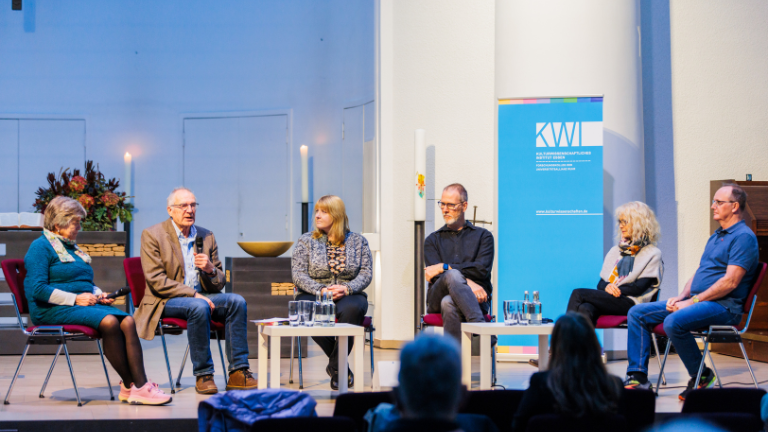
Am 30. Oktober 2025 fand in der Kreuzeskirche Essen auf Einladung des DFG-Forschungsprojekts „Osteuropäische Live-in Hilfen in häuslichen Versorgungstriaden bei Demenz“ eine Buchpräsentation mit anschließender Podiumsdiskussion statt. Im Mittelpunkt stand der Roman Eine Polin für Herrn Kögel (Königshausen & Neumann, 2024) von Barbara Städtler-Mach, ehemalige Professorin für Anthropologie und Ethik im Gesundheitswesen. Das Buch erzählt […]
Rückblick: Expertenrunde Demenz
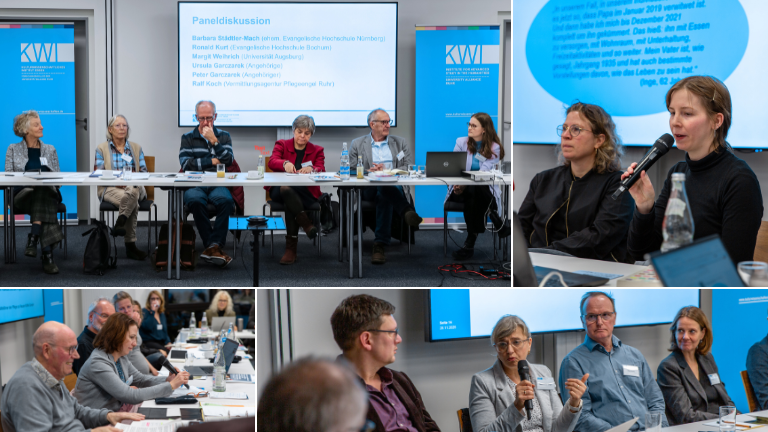
Am 12. März 2025 fand in der Volkshochschule Essen die Veranstaltung „Expertenrunde Demenz: Sie fragen – wir antworten“ statt. Unter dem Motto „Demenz sichtbar machen – Sie sind nicht allein!“ bot die Veranstaltung eine Plattform für den Austausch zur Erkrankung, Versorgung und zum Umgang mit Menschen mit Demenz. Auch das KWI-Forscherteam des DFG-Projekts “Osteuropäische Live-in […]
Interpretationstreffen TriaDe
Am 13. und 14. Februar 2025 fand erneut ein Interpretationstreffen des DFG-geförderten Forschungsprojekts Osteuropäische Live-In Hilfen in häuslichen Versorgungstriaden bei Demenz (TriaDe) statt. Das Projektteam der Universität Oldenburg war zu Gast am Kulturwissenschaftlichen Institut in Essen. Im Rahmen eines intensiven Austauschs wurden an zwei Tagen neue Forschungsdaten analysiert und wertvolle Impulse für die Forschung erarbeitet. […]