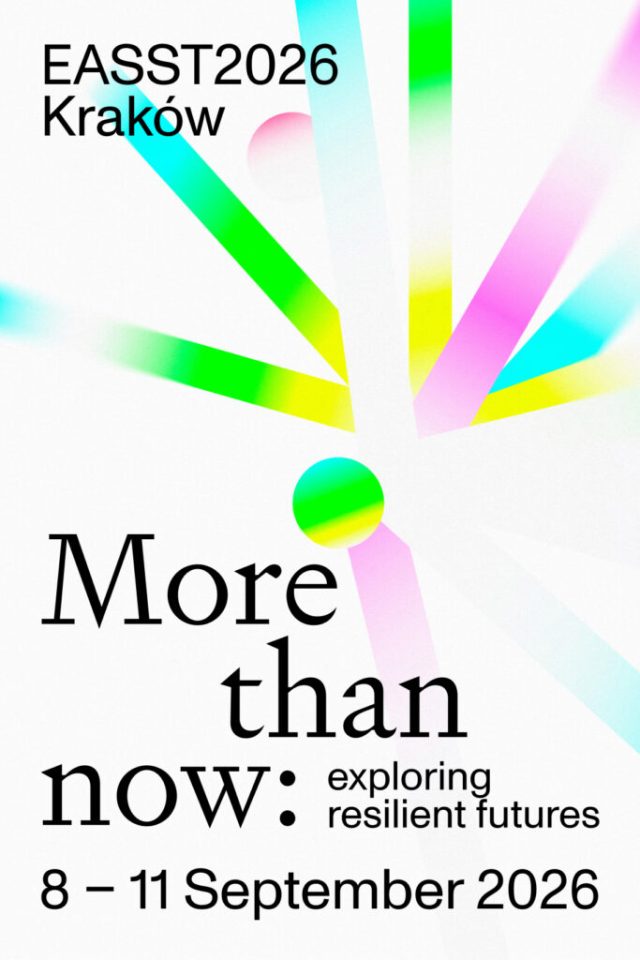
This year, the international conference of the European Association for the Study of Science and Technology (EASST) will take place from September 8 to 11 in Krakow and focuses on „More than now: exploring resilient futures“. The following members of the ERC funded international research project „CryoCultures. Infrastructures, Politics, and Futures of Artificial Cooling“ will be presenting papers.
Zhengfeng Wang, Wednesday 9 September, 09:00-10:30, „Modeling the Cloud: Digital Twins, Data Center Performance, and the Knowledge Politics of Efficiency“:
The deployment of digital twins in data centers promises to optimize performance efficiency, yet the recursive, data-driven processes of real-time monitoring, simulation, and visualization require substantial computing power, linking operational gains to market logics. Read more …
Sebastian Mantsch, Thursday 10 September, 09:00-10:30, „Always On, Always Cooling: The Temporalities of Data Storage and Permanent Digital Availability“:
This paper analyses the tension between ephemeral data storage and its long-term material implications. I propose to examine palimpsestic temporal regimes behind current data storage practices and highlight the cryogenic condition of these “hardwired temporalities” (Volmar and Stine 2021). Read more …
Miriam Fahimi & Akrish Adhikari, Wednesday 9 September, 09:00-10:30, „Cannibal Capitalism and Silicon Ghosts“:
This paper develops a capitalist critique of data centres. Drawing on the concept of cannibal capitalism, we historically and ethnographically examine data centres as key sites for understanding how capital devours and expels the very innovations it brings into being. Read more …
Anastasia Margariti-Börgel & Manuel Harms, Wednesday 9 September, 09:00-10:30, „Frozen Data, Thermal Trust: The fragile promises of Blockchain in Food Supply Chains“:
Food companies deploy blockchain technologies to perform futures of transparent, accountable and sustainable cold chains. This study examines how such sociotechnical imaginaries are co-produced by contradictory infrastructures that undermine their transformative promises. Read more …